Fully immersed module design
Battery cells are fully immersed in cooling fluid, making thermal management an integral part of the module—not just an external cabinet-cooling feature.
Module description · p. 5
Immersion-cooled battery cell modules are at the core of our BESS thermal-management approach. Explore LFP storage for data center power systems, with documented module-level thermal-abuse observations and project-specific integration with UPS, turbines and generators.
UPS, BESS & Substations · Lead Times
12–16 weeks production lead time, plus 4–8 weeks for shipping.
Expediting options are available. Contact us to discuss your project schedule.
Immersion cooling · Thermal management & safety
All BuildingFab battery cell modules use immersion cooling, surrounding the cells with cooling fluid for direct thermal management. Our EP314-1P52S module’s UL 9540A report documents the following safety observations from testing at 100% state of charge.
Source: ANSI/CAN/UL 9540A:2026 module-level report CQES260700094201 · August 11, 2026.
Battery cells are fully immersed in cooling fluid, making thermal management an integral part of the module—not just an external cabinet-cooling feature.
Module description · p. 5
No external flaming or flame extension was observed during the reported module-level thermal-runaway test.
Summary and observations · pp. 3, 18–19
The reported module test recorded no explosion, flying debris, sparks or electrical arcs.
Test observations · p. 18
No additional thermal-runaway events or re-ignition were observed during the report’s post-test monitoring period.
Supplementary observations · p. 19
Results apply to the tested module and conditions, not complete-system certification. Internal cell-to-cell propagation and flammable vent gas occurred during the test; the observations above do not mean zero fire risk.
Full immersion puts cooling fluid in direct contact with the cells. Combined with an engineered enclosure and battery management, this architecture places thermal control at the core of the battery module.
Pair immersion-cooled storage with turbines or generators, UPS and medium-voltage substations for a coordinated data center power solution tailored to your site.
Source: report pp. 4–5, 11. Ratings shown are for the referenced module, not the complete BESS container.
Capacity Options
Entry-level data center battery storage. Ideal for single power block deployments, small-to-mid AI inference clusters, and UPS ride-through extension.
Mid-range capacity for multi-block deployments and training cluster support. Handles sustained peak-shaving across multiple high-density AI racks.
Large-scale capacity for hyperscale campus deployments. Supports full grid-independence during utility disturbances and handles sustained demand events across entire campuses.
Custom capacity configurations above 4 MWh are available for large campus deployments. Contact BuildingFab for project-specific sizing.
Containerized battery storage
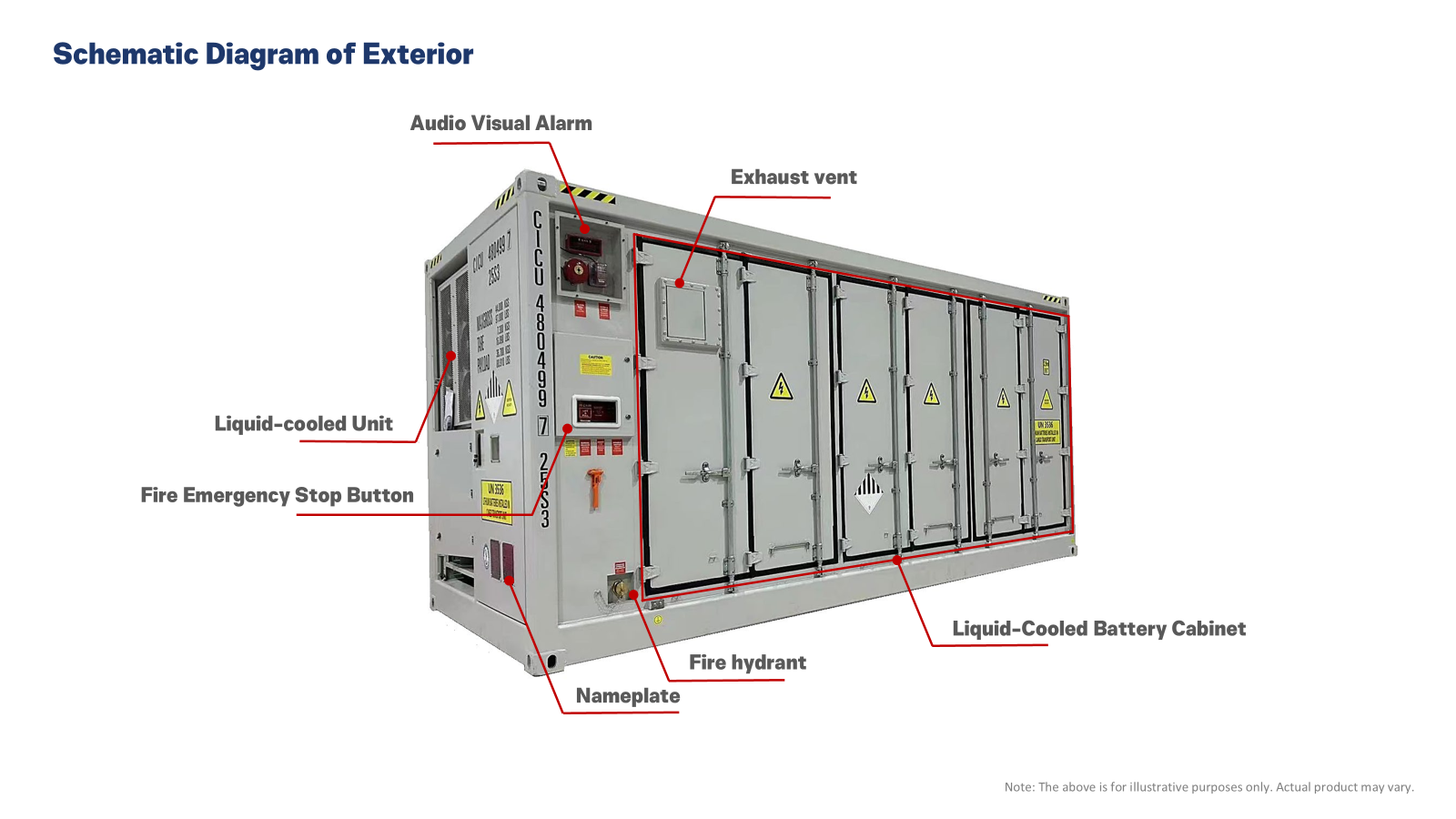
For the BTM reference configuration, each 20-ft storage unit is specified at 2.5 MW / 5 MWh, with a busbar cabinet, immersion-cooled battery cell modules, liquid cooling and fire suppression. Two units form a 5 MW / 10 MWh storage block connected through one 34.5 kV substation. The supplied exterior illustration identifies the equipment interfaces to coordinate during site design; exact model matching requires an approved submittal.
 Open full-size exterior drawing
BuildingFab’s battery cell modules use full-immersion fluid cooling for direct thermal management at the cell level.
The exterior drawing identifies a liquid-cooling unit and exhaust vent. Maintain engineered access and ventilation clearances; heat rejection and auxiliary loads require confirmation.
A local audio-visual alarm provides a visible and audible indication. Alarm logic, remote signals and microgrid integration are defined during engineering.
The exterior includes a labeled fire emergency-stop button. Shutdown actions and coordination with generation, PCS and site protection require an approved cause-and-effect sequence.
The drawing labels a connection as “Fire hydrant.” Suppression agent, detection, water requirements and site fire interfaces must be confirmed with the manufacturer and AHJ.
A labeled nameplate and cabinet access doors support equipment identification and servicing. Confirm final model, ratings, lifting requirements and maintenance clearances before installation.
Sixteen reference BESS units total 40 MW / 80 MWh, paired with eight 5 MW substations. Nominal duration is two hours at full power before losses and operating limits—not guaranteed usable runtime. Turbines or generators provide sustained energy for remote campuses; BESS stores that energy and supports load changes within approved response limits. The EP314-1P52S module report provides model-specific LFP cell and immersion-cooling data. We tailor module selection, DC configuration, thermal management and usable energy to your site’s power requirements and selected container configuration.
Absorbs the rapid, high-amplitude load swings typical of GPU training and inference — protecting upstream grid infrastructure and UPS systems.
Reduce peak demand charges by discharging the BESS during high-intensity compute periods, flattening the load profile seen by the utility.
Supplement UPS battery capacity to extend ride-through from seconds to minutes — providing generator start time and graceful workload shutdown capability.
Isolate critical compute loads from grid voltage sags, frequency deviations, and momentary interruptions without reliance on generator start.
The standard range below is separate from the pictured BTM reference unit. Do not apply these chemistry, efficiency, cycle-life or certification entries to the 2.5 MW / 5 MWh unit without its approved model-specific submittal.
BuildingFab BESS units are designed for direct integration with modular power blocks, UPS systems, and medium-voltage switchgear. Factory acceptance testing (FAT) validates the complete integrated system — including BESS, UPS, and distribution — before shipment.
Power Block Integration
Direct DC or AC coupling to modular power blocks.
UPS Augmentation
Parallel BESS extends UPS ride-through from seconds to minutes.
Cable Tray Infrastructure
Paired with BuildingFab cable tray for complete electrical management.
Get Started
BuildingFab's engineering team will size the right BESS configuration for your power block, UPS architecture, and campus load profile.